Breast Cancer Screening in West Bloomfield: Mammograms, ABUS and AI Support at WHMC
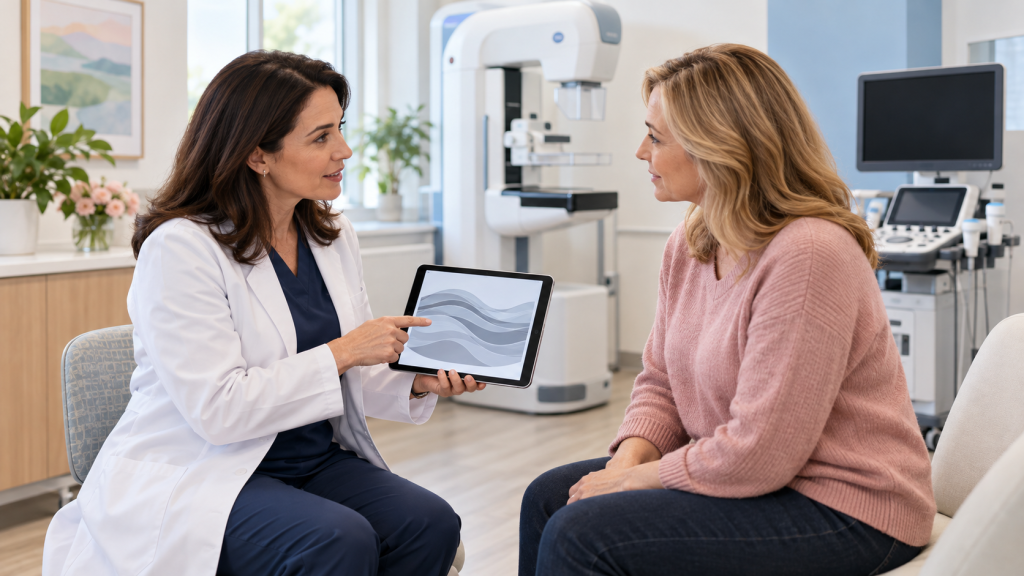
Convenient Breast Screening Close to Home
Keeping up with breast screening is easier when services are convenient and connected to your healthcare team.
Women’s Health and Menopause Center offers breast-screening technology at its West Bloomfield office, helping patients coordinate routine women’s care and breast-health needs in one familiar setting.
The appropriate screening plan varies by age, breast density, family history, symptoms and previous results.
WHMC’s services include 3D mammography, Automated Breast Ultrasound for selected patients and MammoScreen artificial-intelligence support during mammogram review.
3D Mammography for Routine Screening
Three-dimensional mammography, also called digital breast tomosynthesis, captures images from multiple angles.
A computer reconstructs those images into thin layers that a radiologist can review. This approach can make overlapping tissue easier to evaluate than a flat image alone.
The appointment is similar to a traditional mammogram. Each breast is positioned and compressed briefly while the images are obtained.
Mammography remains the primary screening method for most women, even when an additional ultrasound or MRI is recommended.
Learn more about 3D mammography at WHMC.
ABUS for Some Women With Dense Breasts
Dense breast tissue can make a mammogram more difficult to interpret because dense tissue and many abnormalities both appear white.
Automated Breast Ultrasound uses sound waves to create a broad set of breast images and may be considered as supplemental screening for certain women with dense breasts.
ABUS does not replace mammography, and it is not automatically recommended for everyone with dense tissue.
Your provider should consider your complete risk profile, mammogram results and the possible benefits and limitations of extra imaging.
Review WHMC’s information about ABUS and dense breasts.
MammoScreen AI Supports the Radiologist
MammoScreen is an FDA-cleared artificial-intelligence tool that assists radiologists during mammogram interpretation.
The system analyzes image patterns and highlights areas that may deserve additional attention. It acts as a support tool and does not replace the radiologist’s professional judgment.
Using MammoScreen does not require extra compression or a separate patient visit.
WHMC includes the technology with mammograms so the radiologist can consider the AI analysis alongside the images, prior studies, breast density and clinical history.
Read more about MammoScreen at WHMC.
Plan Your Appointment
Before scheduling, tell the office if you have a new breast symptom, implants, prior breast surgery, a personal history of breast cancer, a high-risk family history, pregnancy or breastfeeding.
If previous imaging was performed elsewhere, ask about transferring those records for comparison. Confirm insurance benefits for screening and any supplemental imaging.
Women’s Health and Menopause Center is located at 5777 West Maple Road, Suite 200, West Bloomfield, Michigan 48322.
Review the current location and office hours, call (248) 932-9223 or request an appointment online.
If you are unsure which service you need, the team can help route your request for appropriate clinical review.
A Coordinated Screening Experience
Breast screening is more than the minutes spent obtaining images.
It includes choosing the appropriate test, comparing prior studies, receiving the report, understanding breast density and completing any recommended follow-up.
Keeping these steps connected can reduce confusion and make it easier to maintain a consistent schedule.
At WHMC, patients can discuss breast screening within the context of broader gynecologic and preventive care. That is especially useful when risk may be influenced by family history, reproductive history, menopause care or previous breast findings.
Bring questions to your annual visit and update the team when your history changes.
If you have a breast symptom, mention it when requesting the appointment so the appropriate evaluation can be arranged.
Routine screening and evaluation of a new concern are different pathways. Providing complete information at the start helps the clinical team determine what type of visit or imaging order may be needed.
Bring Your Questions to the Appointment
Before visiting WHMC, list the date and location of your last mammogram, medications, breast procedures and relevant family history.
Note any changes you have observed, even if they seem minor. Ask how results will be delivered and when to call if you have not received them.
Arriving with accurate information helps the team coordinate screening, comparison and follow-up more effectively.