Do You Have Dense Breasts? Why Additional Screening May Be Recommended
What Breast Density Means
Breast density describes the amount of fibrous and glandular tissue compared with fatty tissue as seen on a mammogram. It is not determined by how breasts look or feel.
A radiologist assigns one of four density categories after reviewing the images:
- Almost entirely fatty
- Scattered areas of density
- Heterogeneously dense
- Extremely dense
Breasts are considered dense when they are classified as heterogeneously dense or extremely dense.
Dense breasts are common. Density can change with age, hormonal shifts, pregnancy, menopause, certain medications and changes in body composition.
Why Dense Tissue Matters
Dense breast tissue matters for two main reasons. First, dense tissue and many breast cancers both appear white on a mammogram. This overlap can make a small abnormality more difficult to see.
Second, having dense breasts is associated with a higher risk of developing breast cancer compared with having mostly fatty breast tissue.
Federal mammography rules require facilities to include breast-density information in patient result summaries. The notification is meant to support a more informed conversation with your healthcare provider. It does not mean that every woman with dense breasts automatically needs an additional test.
Should Everyone With Dense Breasts Have More Imaging?
There is no single answer for every patient. Major organizations note that evidence is still evolving about routine supplemental imaging for all women whose only risk factor is breast density.
Additional screening can find abnormalities that were not visible on a mammogram, but it can also lead to more callbacks, short-term follow-up studies and biopsies for findings that are not cancer.
Your provider should consider the full picture, including your age, family history, genetic factors, previous biopsies, past chest radiation, personal history and the findings on your mammogram.
A formal breast-cancer risk assessment may help determine whether supplemental ultrasound, MRI or another approach should be discussed.
How ABUS May Help
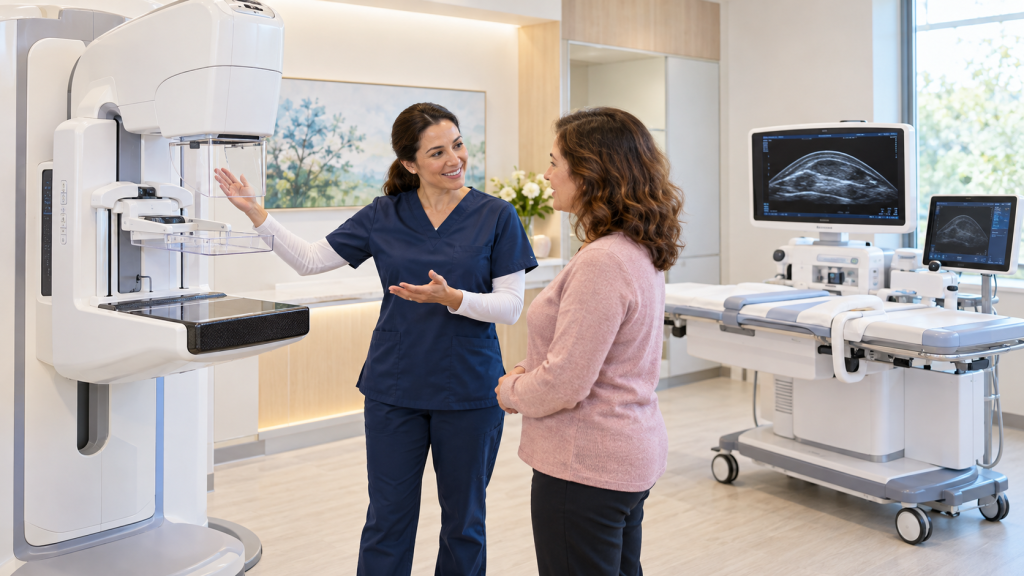
Automated Breast Ultrasound, or ABUS, uses sound waves rather than X-rays to create images of breast tissue.
It is designed to image a broad area of the breast in a standardized way and may be considered as supplemental screening for some women with dense breasts. ABUS does not replace mammography because the tests show different types of information.
During an ABUS exam, lotion is applied to the breast and a scanner is positioned over the tissue to collect images. A radiologist reviews the resulting image set.
If an area needs a closer look, targeted handheld ultrasound or another test may still be recommended.
Read more about ABUS and dense-breast screening at WHMC.
Questions to Ask After Receiving a Dense-Breast Notice
Ask which density category appears in your report, whether you have other breast-cancer risk factors and whether additional imaging would offer a meaningful benefit in your situation.
You can also ask about possible costs, insurance coverage and the chance of a false-positive result.
Women’s Health and Menopause Center offers 3D mammography and ABUS in West Bloomfield. Call (248) 932-9223 or contact WHMC to discuss your screening history and schedule the services recommended for you.
Breast Density Can Change Over Time
A density category is based on the current mammogram and may not remain the same throughout your life. Hormonal changes, aging, menopause, pregnancy, weight changes and some medications can affect breast composition.
That is one reason each new report should be reviewed rather than assuming your density is unchanged from a previous year.
If supplemental screening is recommended, ask whether it is being suggested because of density alone or because other risk factors are present. Also ask how the test fits with your regular mammogram schedule.
Additional imaging should complement, not replace, recommended mammography unless your clinical team provides a different plan. Keep a record of your reports and follow-up instructions so future clinicians can see the full screening history.
Keep Density in Perspective
A dense-breast notice provides useful information, but it should not create panic or be treated as a diagnosis.
Use it as a reason to ask better questions about your overall risk and the limits of each screening test. Continue recommended mammography, report new symptoms and complete any additional imaging your clinical team advises.
The goal is an individualized plan, not the largest possible number of tests.