Choices in Mammography: Detecting Breast Cancer as Early as Possible
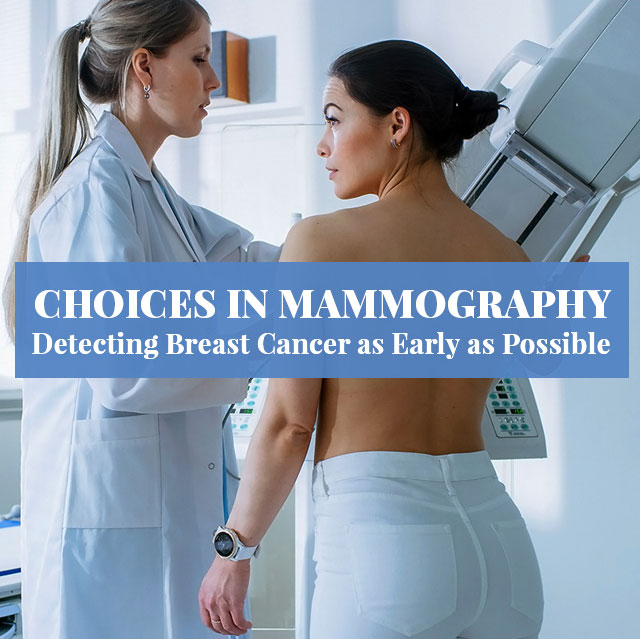
Breast cancer is a concern that lingers on the minds of most women at some point in their lives. The good news is that many patients survive and go on to lead full, long lives. The key is catching cancer as early as possible to increase your chances of a positive outcome. Today, women have multiple options when it comes to breast cancer detection.
- Mammograms
Mammograms are the most well-known breast cancer detection method used today. This approach involves taking an X-ray of the breast to look for changes that are not visible on the outside. While mammograms can be very effective, they do not find approximately one in five breast cancers.
- 3-D Mammograms
3D mammograms deliver a three dimensional X-ray image of the breast, so doctors can view multiple angles and are more likely to notice changes sooner, increasing the potential of catching breast cancer earlier which improves the probability of a better outcome. 3D mammograms advanced technology is also better equipped to look into dense tissue with increased accuracy and better views.
- Ultrasound
A breast ultrasound may be used to identify changes that can be felt but are not visible using a mammogram. It may also be used to look closer at a change that was identified using mammography. This method utilizes sound waves to produce an image of the inside of each breast.
- MRI Scan
A breast MRI is generally used for women who have a breast cancer diagnosis. This type of imaging will measure the cancer and look for other tumors. Women who have a high risk of cancer may be advised to have an MRI scan done as an early detection measure.
- Experimental Imaging
Experimental imaging techniques are being studied to look for improved ways to detect breast cancer. This includes methods like molecular imaging, optical imaging, positron emission mammography (PEM), and electrical impedance imaging (EIT).
If you are due for a mammogram or want to learn more about other screening options, contact Women’s Health and Menopause Center today. Our experienced, board certified OB/GYN’s will help you find the best method for you to increase your chances of early detection.